Chromium is a heavy metal that is used in a variety of industries, including electroplating, leather tanning and metallurgy. It is mostly found in its trivalent and hexavalent forms, Cr (III) and Cr (VI). In its trivalent form, chromium is an essential trace mineral which enhances insulin activity, thus supporting the metabolism of carbohydrates, lipids and proteins.1 However, hexavalent chromium is a highly toxic carcinogen and environmental pollutant.2 The International Agency for Research on Cancer (IARC) classifies Cr(VI) compounds as a group I carcinogen, meaning there is sufficient evidence for their carcinogenicity to humans.3
Over the years, the industrial applications of chromium have generated large amounts of Cr (VI)-containing wastewater, causing pollution of soil and drinking water worldwide (Figure 1). Considering the known risks Cr (VI) poses to human health, it is crucial to implement a fast and reliable method for its detection and monitoring in urban environments.

Figure 1: Sources and risks of Cr (VI)-containing wastewater.
While highly accurate and sensitive methods such as inductively coupled plasma mass spectrometry (ICP-MS) and ion chromatography exist, they tend to be costly, slow, and unsuitable for large-scale on-site screening. Thus, simpler colorimetric methods such as UV-Vis spectrophotometry have become well established for the monitoring of Cr (VI) compounds in wastewater due to their rapid analysis time and high selectivity.
The most widely used UV-Vis quantitative method for hexavalent chromium is a diphenylcarbazide absorption method. As chromium reacts with 1,5-diphenylcarbazide, it forms a red-violet product which can be analysed at 540 nm. The Environmental Protection Agency (EPA) SW-846 Test Method 7196A: Chromium, Hexavalent (Colorimetric), is used to determine the concentration of Cr (VI) in water and ascertain whether it adheres to EPA’s drinking water standard for total chromium of 0.1 mg/L.4, 5
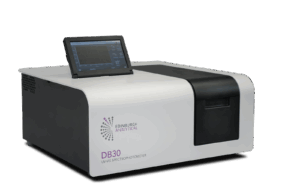
In this Application Note, an Edinburgh Analytical DB30 UV-Vis Spectrophotometer (Figure 2) was used to determine the concentration of Cr (VI) in ground water. By generating a calibration curve of solutions of known Cr (VI) concentration, the unknown concentration in water from the River Almond in Livingston (Scotland, UK) could be determined according to EPA’s Method 7196A.4
Figure 2: An Edinburgh Analytical DB30 UV-Vis Spectrophotometer.
All reagents and standards were prepared following the EPA Method 7196A.4 A standard stock solution of 50 mg/L was prepared by dissolving potassium dichromate (Thermo Fisher) in deionised water. 10% v/v sulfuric acid solution (Thermo Fisher) was used to adjust the pH of the solutions. A 1,5-diphenylcarbazide (DPC) solution was prepared by dissolving 250 mg of DPC (Sigma Aldrich) in 50 mL of acetone (Uvasol). Standard Cr (VI) solutions of 0.1, 0.2, 0.3, 0.4, 0.5, 0.6, 0.7, 0.8, 0.9 and 1.0 mg/L were prepared from the stock solutions (Figure 3).

Figure 3: Standard Cr (VI) solutions from 0.0 mg/L to 1.0 mg/L (left to right).
Sample water was collected from the River Almond. A solution made up of 95 mL sample water and 2 mL DPC solution was prepared. The pH of the solution was adjusted to 2 ± 0.5 with the 10% v/v H2SO4, then made up to 100 mL with deionised water.
A spiked river sample was also prepared following the same method, with the addition of 5 mg/L Cr (VI) standard solution. The samples were loaded into 10 mm pathlength cuvettes (Figure 4).
Since the native river sample did not undergo the expected colour change during the reaction with DPC, it was anticipated that the levels of chromium in the River Almond would be low. The prepared chromium standard solutions for calibration were treated by the same procedure as the samples, in order to compensate for slight losses of chromium during the analysis, and develop their colour.

Figure 4: River sample solutions. Native river sample (left) and spiked river sample (right) in 10 mm pathlength cuvettes.
Measurements were carried out on the DB30, using the instrument’s touchscreen interface. The Hexavalent Chromium photometry mode, with predefined parameters and measurement methods for this specific testing, was used (Figure 5). A first order curve type was selected, and the number of standards and their concentrations were entered (Figure 6). All readings were taken at 540 nm since the reaction of chromium with excess DPC gives a red-violet product with a characteristic absorbance at that particular wavelength.

Figure 5: Experimental parameters on DB30 UV-Vis Spectrophotometer touchscreen interface.

Figure 6: Concentration graph setup on DB30 UV-Vis Spectrophotometer touchscreen interface.
The calibration curve produced using Cr (VI) standard solutions was confirmed as first order, with R2 = 0.9995 (Figure 7). It was then used to determine the concentration of hexavalent chromium in the prepared sample solutions from the River Almond.

Figure 7: Cr (VI) standard calibration curve, taken from the DB30 touchscreen interface.
Following the acquisition of the calibration curve, a photometry scan was carried out at 540 nm in order to determine the absorbance and concentration of Cr (VI) in the river samples (Table 1).
Table 1: Absorbance and concentration values of river samples at 540 nm, taken from the DB30 touchscreen interface.

The native river sample, 1-1, yielded a Cr (VI) concentration of 0.0014 mg/L. This demonstrated that the water in the River Almond is within EPA’s water regulations for total chromium, with a limit of 0.1 mg/L.5 Additionally, since the solution did not develop a red-violet colour during sample preparation, it was anticipated that the levels of chromium would be low. This result indicates that the water in the River Almond does not contain enough Cr (VI) to pose a threat to human health, aquatic life, and the environment.
To verify the validity of the method, sample 2-1 was spiked with a known volume, 13.5 mL, of the 5 mg/L Cr (VI) standard solution. The concentration of the sample was expected to fall between 0.4 and 0.5 mg/L, and the experimental result of 0.4340 mg/L agreed with this theoretical expectation.
This Application Note illustrates the use of the Edinburgh Analytical DB30 UV-Vis Spectrophotometer for the determination of hexavalent chromium in river water. UV-Vis spectrophotometry was demonstrated to be a fast, sensitive and cost-effective method for research and industrial analysis of chromium in water. The DB30 offers a pre-saved method for photometric determination of hexavalent chromium, providing a selective and rapid analysis method, enhanced by the user-friendly touchscreen interface of the instrument.